

Welcome our topic for today is about
electric parking brake in this discussion we covered
1. introduction of EPB:
2. EPB components
3. working principle
4. types of EPB
5. benefits and disadvantages
1. Introduction of EPB
The electric park brake functions as a conventional hydraulic brake for standard service brake applications and as an electric brake for parking and emergency braking.
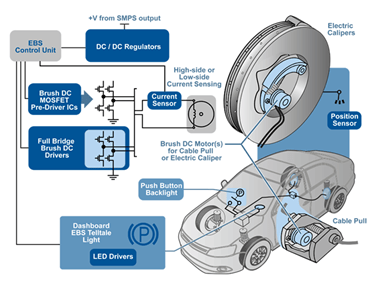
Electric park brake is a caliper with an additional motor that operates the parking brake. The EPB system is electronically controlled and consists of the EPB switch, the EPB caliper and the electronic control unit(ECU). The electric parking brake or the EPB is an advanced version of conventional parking brake or handbrake. Sometimes people also refer to this system as electronic parking brake.
Technically the system is a subpart of brake by wire system. The main function of parking brakes is to avoid motion of vehicle when parked. In addition, these brakes also play an important role in
avoiding backward motion of vehicle which resumed moving on a slope.
Generally parking brakes operate only on the rear wheels of a vehicle. EPB functionality relies on four elements: control switched, a wheel speed sensor, a force sensor, electric motor. Together, these monitor a variety of input signals and determine when to apply or release the brakes.
2. Components
a) Electronic brake module
b) Actuator or electric motor
c) Electric switch
3. Working principle
Conventional parking brakes employ a cable that connects handbrake lever and brake shoes. When the driver operates the lever, tension in the cable Increases. Thereby forcing the brake shoe (or pads) on brake drum (or disc). Thus wheels cannot move further. When the driver operates the switch, it sends a command to module which senses that parking brakes are required to be operated. Later this module commands the actuators or electric motors installed in the brake calipers to operate. Thus brake pads are forced on the disk thereby restricting the movement of wheels.
Due to the use of electronic components the operation of this system is almost instantaneous and efficient. Also it improves the reliability of braking because of the absence of mechanical connection. This brake deactivates automatically when the driver presses the accelerator pedal. Some vehicle manufacturers also integrate assist function with this system.
4. Types of EPB:
a) Cable pull system
b) Electro hydraulic system with ESP
c) Electric parking brake drive by wire system
The cable pull system is simply a development of a traditional lever and cable method.
As the switch is operated a motor or motors pull the cable by either rolling it on a drum or using an internally threaded gear on a spiral attached to the cable.
The electronic parking brake module also known as the EPB actuator, is fitted to some Range Rover and Land Rover modules. The parking brake can be released manually on most vehicles. After removing a plastic cover or similar, pulling a wire cable loop will let off the brake.
Cable-Pull Systems (with parking brake lever)
Benefits:
Low cost at time system is installed to the vehicle cable pulls systems with parking brake lever
Disadvantages
No driver assists fully manual
low reliability and safety due to driver in the loop.
Requires package space and interior.
Routing and adjustment of thick mechanical Bowden cable`s in production.
Aging of cables and poor clamp force stability over lifetime
Weight
Cable-pull Systems (with EPB actuator)
Benefits
Driver assist functions
Small switch in interior
Cable-Pull system (with EPP actuator)
Disadvantage
Parts cost and installation effort.
High technical effort for cable puller unit fixation and noise insulation.
Aging of cables and poor clamp for stability over lifetime. Brake is often overloaded.
Durability limitations at higher cable loads.
Low reliability due to sticking
Cables, single motor drive approach,
overloaded brake actuators, etc.
Electric-Hydraulic Caliper Systems
These types are usually employed as part of a larger control system such as an electronic stability program(ESP). When the driver presses the switch to activate the parking brake, the ESP unit automatically generates pressure in the braking system and presses the brake pads against the disc. The calipers are then locked in position by an electrically controlled solenoid valve.
The caliper remains locked without any need for hydraulic pressure. To release the brake, the ESP briefly generates pressure again, slightly more than was needed to lock the caliper, and the valve is released.
Electric Parking Brake drive by wire systems
The drive-by-wire system was developed by Continental. It uses an electric motor and gearbox to apply pressure on the pads and therefore onto the disc. A key component is the parking brake latch. This is like a ratchet and it prevents the pressure in the piston from rotating the motor and it therefore keeps the brakes applied.
Benefits
Modular architecture, scalable clamp load and durability with reduced hysteresis
Significant weight savings compared to mechanical park brake systems to support enhanced fuel economy and reduced emissions
Vehicle coverage from small car to light trucks segments
Electronic control allows for integration with other safety technologies
Pioneered EPB technology in 2000 and now in fifth generation with more than 90 million EPB calipers on world roadways
The response time of this system is very short
The operation is highly reliable
Improves control of the vehicle while starting from standstill condition on a slope.
Disadvantages
This system is costly
It needs a skilled professional for troubleshooting
This can also prove the quality of our products