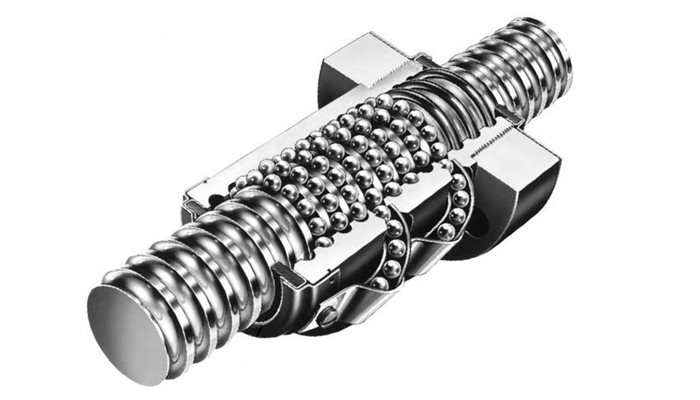
The ball bearings in the ball screw roll along the rails in a manner similar to the ball bearings in the standard rotating ball ring, thus eliminating the sliding friction associated with the screw.
The ball bearing is constantly circulating through the ball nut, distributing the load and getting lubricated along the way.
Due to the use of rolling ball bearings inside the ball screw, the internal friction is very low, which means that the ball screw provides a high level of efficiency and positioning accuracy even under high torque and force loads.
Ball screws are very complex and high-precision equipment, which means they are sometimes slightly more expensive than a typical screw.
This is due to the complex machining and assembly techniques required to manufacture them.
However, if your application requires ball screws, then higher performance is often more important than cost
Ball screws work in a similar way to traditional screws, but the significant advantage of using a ball screw is that it uses ball bearings running in spiral channels to transfer loads.
In high precision applications, it is often necessary to convert the rotary motion of the motor into the linear motion of the payload.
One way to do this is to use ball screws.