

Today, let's talk about why ordinary ball screws cannot be used in the actuators of Tesla's hands and legs. There's no need to go over the principle of ball screws again. Let's talk about something new. Everyone knows the basic concept that a ball screw is a Goethe-type raceway, where the steel balls contact two points at a 45-degree angle. During movement, the steel balls rest on these two 45-degree points to move. Because the entire operation is point contact, it is very smooth. Can you understand this? If you can understand this, then you can understand that its efficiency is very high. What does high efficiency mean? If you use it as a force source and push this smooth screw, is it not effortless? It's like a cart with wheels. If you give it a very large force, won't the small cart be pushed 10 meters away in an instant, seemingly without any effort? Well, I'll tell you that its efficiency is 90%, which means that of the force you give it, only 10% is lost during operation. If you can understand efficiency, then you can understand that the efficiency of planetary ball screws is around 75%, which means you don't have to exert as much force.
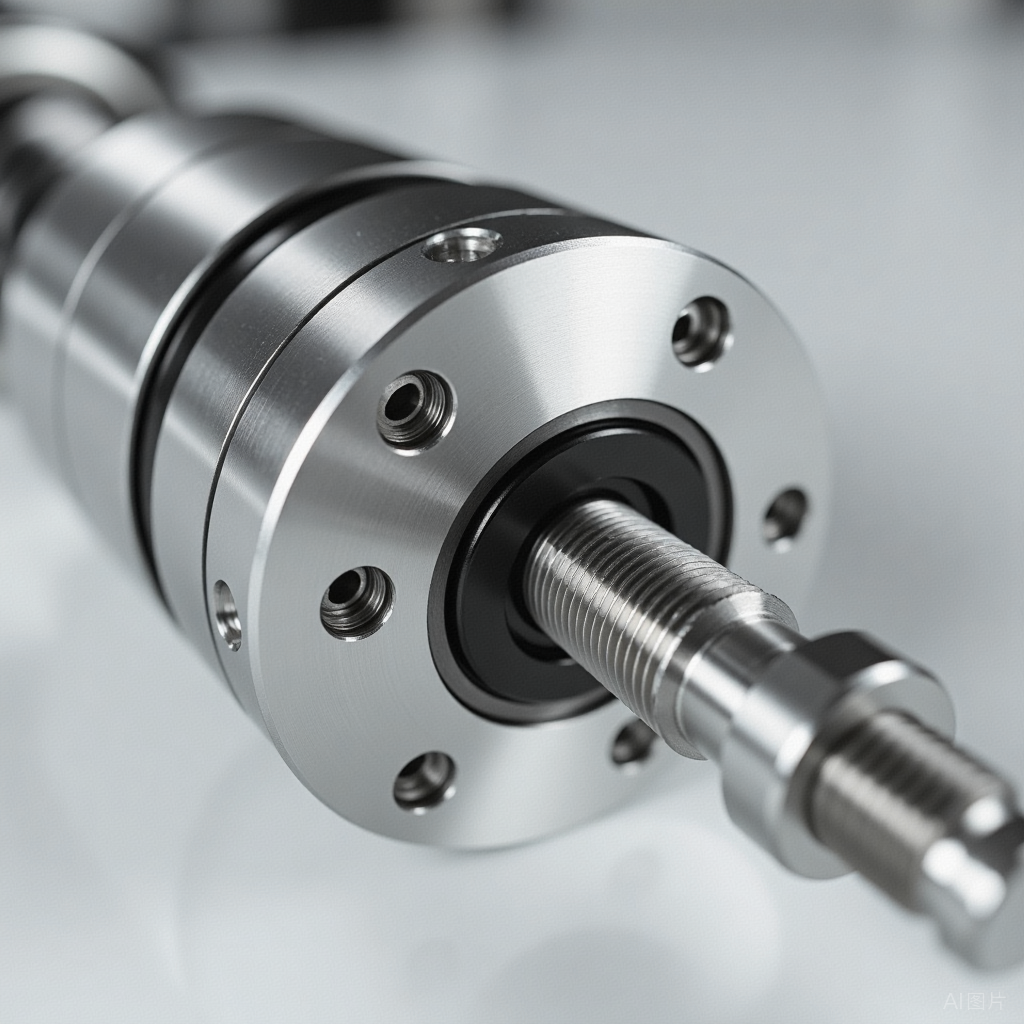
Now, the problem arises. Although your small cart is smooth, if you load it with one ton of goods and push a heavy object, this heavy object will also push back against your force source (motor). You are sandwiched in the middle, bearing the force from both sides. One side bears the huge torque output from the motor, and the other side bears the pressure from the heavy object. At this point, as a point contact, you are in great pain because your steel balls are about to burst. Therefore, the lifespan of a ball screw is only one-tenth of that of a planetary roller screw. Yes, you heard it right. The lifespan of a planetary roller screw is ten times that of a ball screw. If you have no questions up to this point, congratulations, your comprehension is really good. So, what is a planetary roller screw? As the name suggests, a planet has to revolve around and rotate on its own axis to be called a planet. Therefore, during the operation of a planetary roller screw, there is no sliding friction between the screws, nor is it point friction. It is rolling line friction. That is, since it doesn't rub against the ground, it doesn't wear out, or the wear is very small. This is one of the sources of its long lifespan. Secondly, its rollers are a bit longer. Unlike ball screws, which are like eggs, they are like flat bars. When they bear a load, there are 6, 8, 9, or 11 flat bars, sharing the huge load with the main screw. Because it doesn't rub against the ground, its efficiency is not low either, but it's not as high as that of a ball screw. However, it's not too low either. The next point is the fatal core reason why ball screws cannot be used as actuators. That is, ball screws have no self-locking force at all. They can even be crushed by their own weight because they are too smooth. In contrast, planetary roller screws have a certain "self-locking force", which can buffer or be understood as having a certain counterforce, but they cannot completely self-lock.
So, what are the benefits? During operation, when you are pushing a heavy object, you know the principle of force is mutual. When you apply pressure to an object, the object exerts a counterforce on you. So, when a planetary roller screw is under load, the self-locking force of the planetary roller screw can share part of the load without transmitting it to the motor end, preventing motor stalling. Thus, the motor is effectively protected or does not reach its power peak. That is to say, you don't have to exert so much force. If the motor stalls for a long time, it will overheat and burn out. OK, so what does this have to do with humanoid robots? You know, on the legs and arms of robots, there are linear actuator joints, which are used to carry loads, just like human muscles. If you stand, where is your center of gravity? That's where the load is. Your linear actuator starts to work and bear the load. At this time, if it's a regular ball screw, the motor will consume a lot of power because it's not self-locking and all the load is returned to the motor. The motor has to work hard. If the load gets bigger and bigger, the motor can't handle it and it gets stuck. It starts to heat up. So the heavy-load characteristics and self-locking ability of planetary roller screws effectively help the motor reduce its workload, extend its service life, and save electricity! Isn't that great? Well, if you have any questions, leave a comment in the comment section.